Ethereum needs successful smart contracts to thrive.
A DAO is only a name for a type of smart contract.
Token and delegation based DAOs are only one variation of smart contracts.
This type of token and delegation based DAO hasn't technically innovated in any real direction since its inception via the Compound Governor contract.
Now we wonder why these DAOs are 'failing'. It's not that the idea of smart contract controlling capital is any less valid, it's that we've tried to scale interplanetary coordination systems with purely financialised mechanisms, an underused delegation structure, broadly low token holder engagement, and an unwillingness to disburse meaningful amounts of tokens to prospective contributors by existing power brokers, foundations, etc.
Well-capitalised organisations and individuals have taken positions in protocol ownership and proceeded to not utilise or engage with decentralised governance at all. This is a primary factor of the governance failure tokens are current experiencing; How can a protocol be governed with tokens if token holders are unwilling to govern and distributions aren't equal? We need to build new governance experiments while still empowering nimble teams to deliver protocol value.
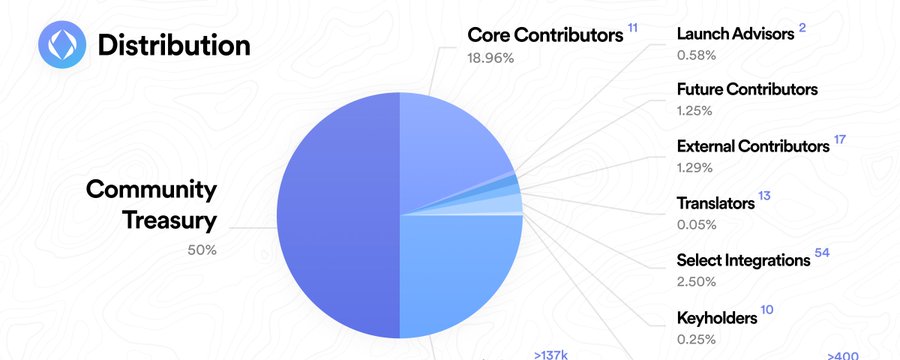
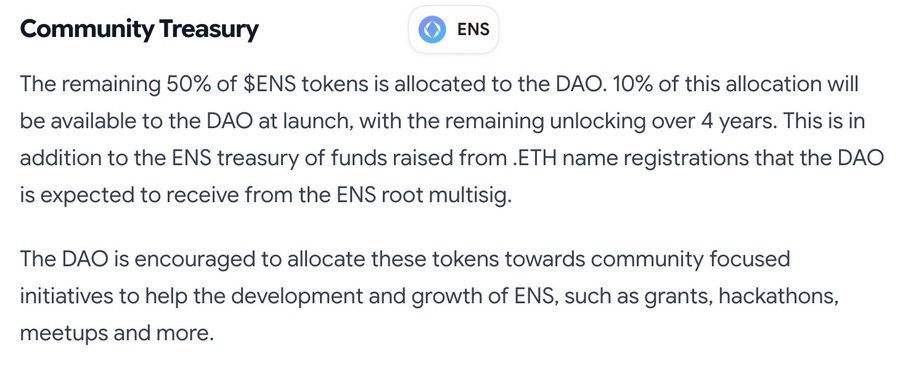
This governance failure is playing out in real time within ENS DAO, where ENS Labs is proposing to move the entire ~$400 million dollar treasury away from decentralised token control and into a insider multisig controlled by ENS Labs and Foundation. Name registration revenue has always been a central aspect of the DAO's mandate and control, let alone 50% of the token supply that was intentionally earmarked for DAO and community control:
These concerns have been highlighted by a majority of the ENS community, service providers and contributors on twitter, the forum and "Save ENS" chat groups.
Whilst ENS DAO currently has a security council to prevent these types of governance, treasury and protocol attacks, the security council itself is now under attack in the same way;
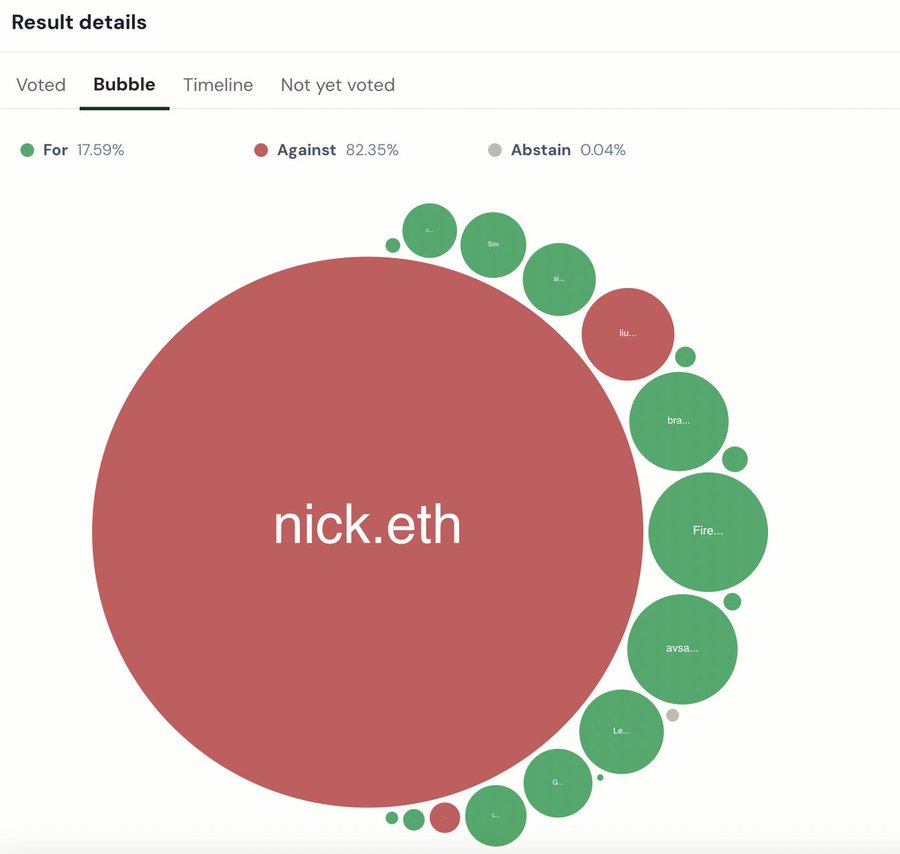
After the expanded foundation proposal 10 days ago, Nick.eth delegated himself 3,000,000 ENS tokens, ~2x the votable supply, before publicly stating that he would veto any security council that wouldn't accept the foundation proposal (Since the security council proposal is now onchain, Nick.eth has now voted against the current security council and instead signalled towards Katherine's new security council proposal, where Nick can then select security council members who are aligned with Labs' direction). Meaning ENS governance has been entirely captured by Nick.eth, something that not only harmful to the ENS protocol but also the entire community spirit of ENS.
The ability Nick has to delegate this many tokens is something Fire Eyes was significantly responsible for, building the initial ENS distribution spreadsheet and working with Nick and Brantly on individual allocations. After Brantly was removed from his position (something we were also directly involved in) his token allocation was significantly reduced. In retrospect, these tokens would have been one of the only backstops against this kind of capture.
These are all unexpected moves given Nick's motivation to launch the DAO in the first place back in 2021:
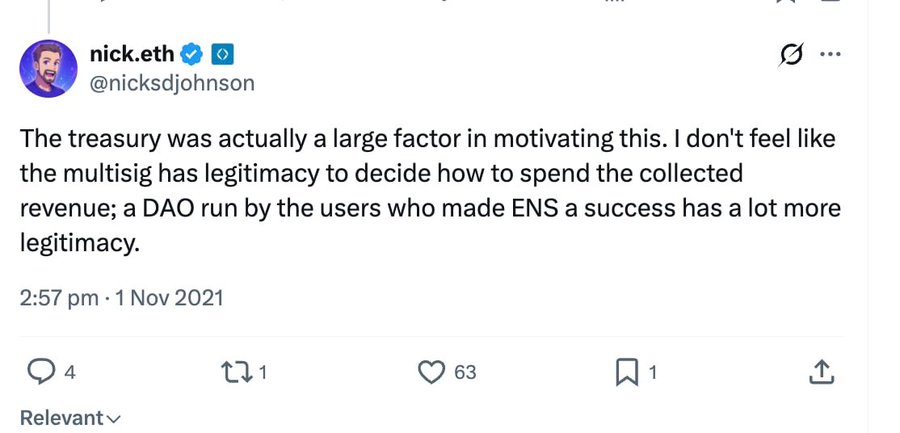
This compared to the current Labs position of tweeting carefully crafted legalese with comments turned off, is a sad comparison;
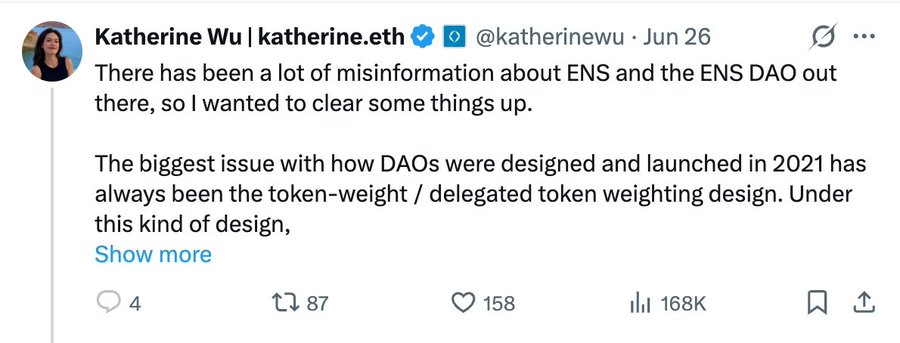
This situation has been caused by a number of moving parts;
- Trying to innovate at a protocol level with a globally distributed group of humans is hard.
- ENS Labs feels the DAO is counter productive and slowing down their growth.
- The DAO (and it's community) genuinely want to build ENS into a better product and experience.
- Deciding how the treasury is controlled, budgets assigned and livelihoods paid for is a delicate ongoing process.
How can ENS move forward given the crossroad between community and control?
🔥_🔥 has consistently tried to build structures inside of Ethereum with a truly decentralised heart and with strong alignment to Ethereum's core values. Where communities can genuinely help build the success of the projects they want to support and own. Seeing the current moves from leadership teams across the space and within ENS is deeply saddening. Giving up on DAOs and going straight back to the centralised power structures that we're here to reinvent in such a blanket way, is giving up on a type of smart contract and a type of digital human coordination that will continue to genuinely make a positive impact on humanity.
There are very few projects within Ethereum that have the cultural relevance of ENS, .eth names are deeply linked to the cultural identity of Ethereum's community. This type of project giving up on decentralisation in such a monumental way is incredibly sad for Ethereum's prospects. In a time of such global chaos and change, trying to innovate on genuine governance design for interplanetary protocols shouldn't be abandoned, it should be embraced.
We view ENS as one of the last bastions of Ethereum where we should be developing new systems (and smart contracts) as opposed to reverting to governance and financial structures of the past. Taking steps to innovate on governance, decentralised ownership and coordination should be a primary goal of ENS DAO while the wider industry capitulates.
We would fully support an ENS DAO roundtable (preferably in real life, given the scale of ENS as a protocol) having facilitated discussion and strategic planning sessions with ENS DAO core contributors, ENS Labs, delegates, service providers and stewards. Mike from Metagov has signalled some willingness to facilitate this and it is something we would be excited to engage with regardless of the specific facilitator.
With the goal of building an Amended Proposal where an ENS foundation could still be empowered with operational capacity while also ensuring the ENS DAO maintains control over the treasury and direct financial accountability. At the same time taking steps to innovate on the simple token voting governance contracts of today.
We implore the ENS Labs team and Nick.eth to consider the long-term impacts of these ideas on the ENS community, protocol support and Ethereum as a whole. Trying to engage in good faith with the ENS community in order to find a workable solution that does not strip the protocol, DAO and community of their impact and ownership.